The Third Shot Drop in Pickleball, Explained
Ask experienced doubles players which shot separates beginners from intermediate players, and many will name the third shot drop. It is not flashy, but it solves the biggest problem the serving team faces.
Why the third shot is a problem
To understand the drop, start with the first three shots of a rally:
-
The serving team serves.
-
The receiving team returns the serve. Because of the two-bounce rule, the serving team must let this return bounce, so they are stuck near the baseline.
-
The serving team hits the third shot.
By the time of the third shot, the receiving team has usually moved up to the kitchen line. They are in the strongest spot on the court, and you are in the weakest spot, back at the baseline, about 15 feet behind your own kitchen line. If you hit a normal, firm shot at them, they can volley it down at your feet before you get any closer.
The third shot drop is the answer. It is a soft, arcing shot that drops into your opponents’ kitchen, forcing them to let it bounce or hit it up. That buys you time to move forward and join them at the net.
What a good third shot drop looks like
A good drop has three qualities:
-
It lands in the kitchen, ideally in the half closest to the net or near your opponents’ feet.
-
It arcs up and comes down. The ball’s highest point should be on your side of the net, so it is already falling when it crosses.
-
It is unattackable. Your opponents have to hit up on it. They do not need to miss it; they just cannot smash it.
The shot does not need to be perfect. A drop that lands a foot past the kitchen line but stays low is still doing its job.
How to hit the third shot drop
Get set early
As soon as you see the return coming, move behind the ball and get your feet set. Rushing is the main reason drops fail. Let the ball bounce and come to you, and try to hit it out in front of your body.
Use a relaxed grip
Hold the paddle in a continental grip with light pressure. A loose grip takes pace off the ball. A tight grip makes the ball fly.
Swing low to high
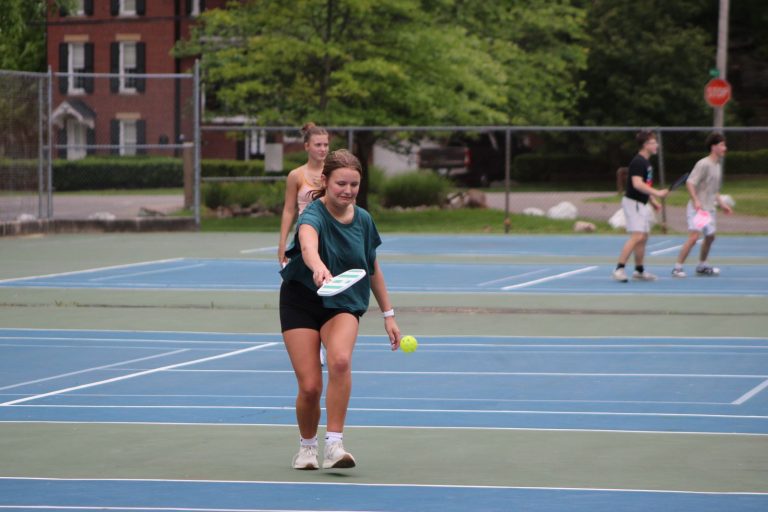
The drop is basically a long, slow version of a dink:
-
Bend your knees and get low, so your paddle starts below the ball.
-
Keep the paddle face slightly open, angled upward.
-
Take a short, smooth backswing. There is no need for a big wind-up.
-
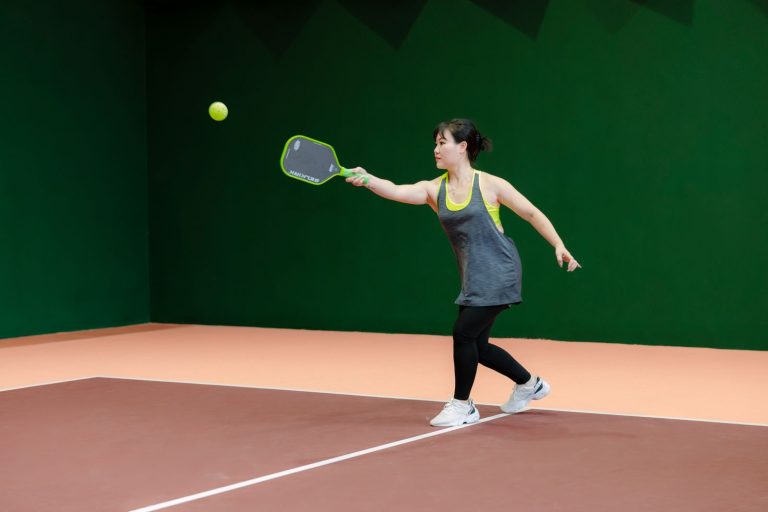
Lift the ball with a gentle low-to-high motion, driven by your shoulder and legs rather than your wrist.
-
Follow through toward your target, up to about chest or shoulder height.
Think “lift and push,” not “hit.”
Move forward after you hit
The drop only matters if you use the time it buys you. After you hit, take a few steps toward the net and then split step, a small hop that lands you balanced on both feet, as your opponents hit the ball. Keep moving forward in stages until you reach the kitchen line.
Where to aim
-
Cross-court drops are the safest. The ball travels over the lower middle of the net and has more room to land.
-
Toward the backhand of the player across from you, if they are noticeably weaker there.
-
Into the middle, between the two opponents, can create confusion about who should take it.
Aim for the net to be your measuring stick. Picture a target a few feet above the net on your side, at the top of the ball’s arc, rather than focusing on the spot where it lands.
Drop or drive?
The third shot does not always have to be a drop. The other option is the third shot drive, a hard, low shot aimed at your opponents’ feet or body. Good players mix the two.
Choose a drive when:
-
The return is short or high, and you can step in and hit with a high contact point.
-
One of your opponents is still moving forward and is not set at the line.
-
An opponent struggles with pace.
Choose a drop when:
-
The return is deep and low, pinning you back near the baseline.
-
Both opponents are already set at the kitchen line.
-
You are off balance or late.
A popular tactic is to drive the third shot and then hit a drop on the fifth shot. The drive forces a weaker reply, and the drop helps you get forward from there. This is sometimes called the “drive and drop.”
Common third shot drop mistakes
-
Hitting too flat or too hard. The ball goes deep or gets volleyed.
-
Swinging with the wrist. Your drops will vary wildly in height and length.
-
Standing up during the shot. Lifting your body pulls the paddle up early and the ball flies.
-
Watching your shot instead of moving. If you stay at the baseline, the drop was wasted.
Drills to build a reliable drop
Dinks to drops
Start at the kitchen line dinking with a partner. After every few dinks, take one step back. Keep going until you are at the baseline. This builds the feel of a drop gradually instead of all at once.
Feed and drop
Your partner stands at the kitchen line and feeds balls to you at the baseline. You hit drops back. Count how many land in the kitchen out of 20. Your partner can also tell you whether each one was attackable.
Drop and approach
Same setup, but after each drop you move forward and split step. Your partner returns the ball softly, and you play it out from wherever you are. This practices the full pattern, not just the shot.
Live third shot games
Play points where the serving team must hit a drop on the third shot. It is frustrating at first, but it builds the shot under real pressure.
FAQ
Is the third shot drop needed in singles?
It is much less common in singles. With one player covering the whole court, passing shots and deep approach shots usually work better. The drop is mainly a doubles shot.
Why do my third shot drops keep going into the net?
You are likely not getting low enough or not lifting. Bend your knees, open the paddle face a little and finish your swing higher.
How long does it take to learn the third shot drop?
It varies, but expect weeks of regular practice before it feels dependable. Focus on keeping the ball unattackable first, and on exact placement later.
Should beginners even try the third shot drop?
Yes, but without pressure. Use it in practice and casual games. Even an imperfect drop teaches you the soft, controlled stroke that dinks and resets depend on.
Quick recap
-
The third shot drop lets the serving team get from the baseline to the kitchen line safely.
-
Aim for a soft arc that peaks on your side and lands in the kitchen.
-
Use a relaxed grip, get low and lift the ball from low to high.
-
Move forward after the drop and split step as your opponents hit.
-
Drive when the return is short or high; drop when it is deep and low.