Pickleball Serve Rules and How to Hit a Reliable Serve
Every point in pickleball starts with a serve, and unlike tennis, you only get one try. That sounds stressful, but the serve is the one shot you fully control. Learn the rules, settle on one simple motion and you can take serving faults almost completely out of your game.
What the serve needs to do
The serve has one job: get the ball over the net and into the service court diagonally across from you. It is not the big weapon it is in tennis. The receiver must let it bounce, and the serving team must stay back to let the return bounce too, so even a great serve rarely wins the point by itself. A reliable, deep serve is worth far more than a fast one that misses one time in five.
Where you stand: foot position
When you hit the serve, your feet have to follow three rules:
-
At least one foot must be on the ground behind the baseline. Jump serves are not allowed.
-
Neither foot may touch the baseline or the court in front of it.
-
Your feet must stay between the imaginary extensions of the centerline and the sideline of the court you are serving from.
The most common foot fault is a toe creeping onto the baseline as you step into the shot. An easy fix is to set up a full shoe length behind the line. You lose nothing by standing a little deeper.
Which side you serve from
In singles, you serve from the right side when your score is even (0, 2, 4) and from the left when it is odd.
In doubles, things depend on the score and the server number:
-
The game starts at 0-0-2. The first serving team gets only one server before the serve passes to the other side.
-
After each side out, the player standing on the right side of the court serves first.
-
When the serving team wins a point, the server switches sides with their partner and serves again from the other court.
-
When the serving team loses a rally, the server stays put and the serve goes to the partner, or to the other team if both partners have served.
Before every serve, the server calls the score: serving team’s score, receiving team’s score, then server number. Once the score is called, you have 10 seconds to serve. Our guide to pickleball scoring covers server numbers in more detail.
The two legal serves
The rulebook allows two kinds of serve. You can use either one on any point.
The volley serve
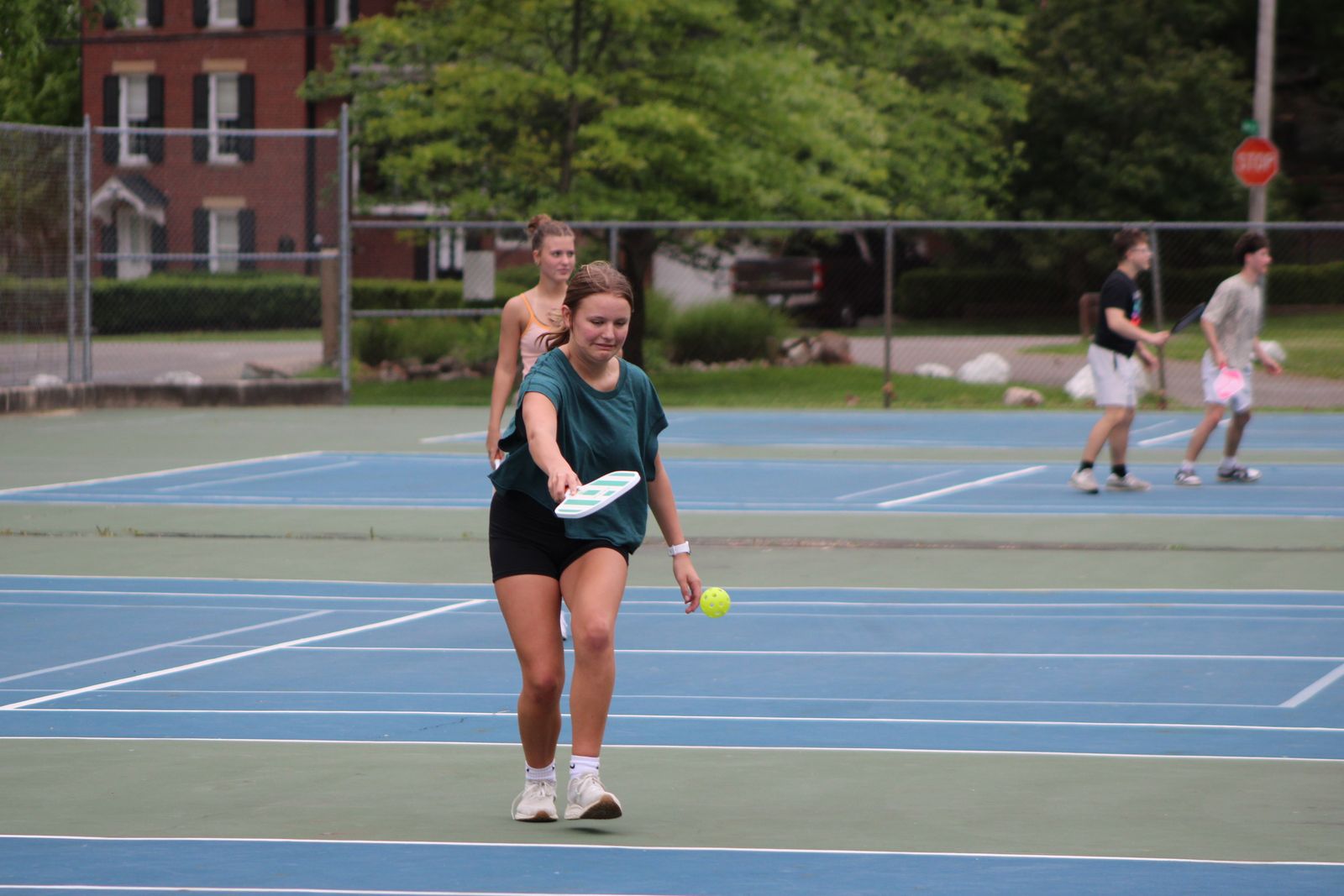
This is the traditional serve: you hold the ball, release it and hit it out of the air. At contact, three things must be clearly true:
-
Your arm is moving in an upward arc.
-
You strike the ball below your waist, meaning below your navel.
-
The head of the paddle is below your wrist. The highest part of the paddle head cannot be higher than the highest part of your wrist joint.
Together these rules mean the serve has to be an underhand motion. A sidearm slap or a tennis-style overhead is a fault.
The drop serve
With the drop serve, you let go of the ball, let it bounce on the court and then hit it. The upward-arc, waist and wrist rules do not apply, so you can use almost any swing you like after the bounce.
There is one important limit: you must simply drop the ball from your hand. You cannot toss it up or throw it down to get a higher bounce. You can drop it from any natural height.
For many beginners, the drop serve is the easier choice: there is less to think about and it is hard to break the motion rules.
Spin on the serve
Spin is allowed, but only from your paddle. You may not use your fingers or hand to spin the ball as you release it, on either type of serve.
How to hit a reliable serve
Here is a simple, repeatable routine for the volley serve. The same setup works for the drop serve; just let the ball bounce before you swing.
-
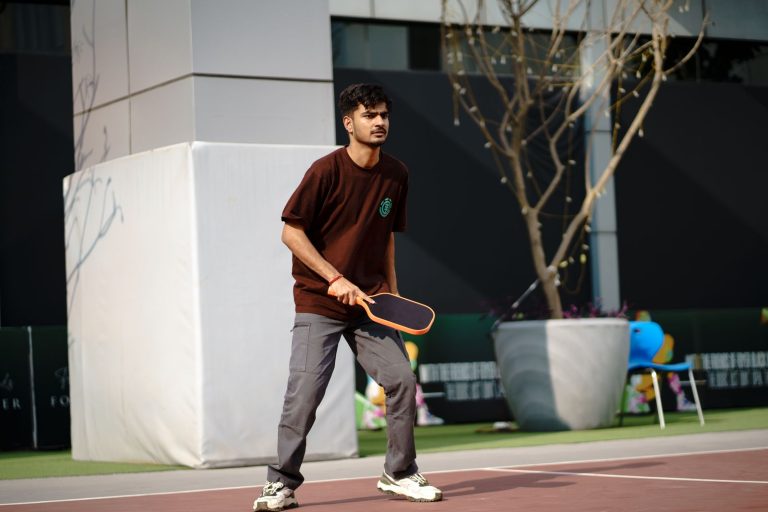
Stand sideways-ish. Set your feet roughly shoulder-width apart, with your non-paddle foot slightly forward and pointing toward your target.
-
Hold the ball in front of you, around waist height and out to the side of your front foot, so your paddle has a clear path to it.
-
Start with the paddle back and low, below your waist, with your wrist firm.
-
Release the ball gently. Do not throw it; just open your hand.
-
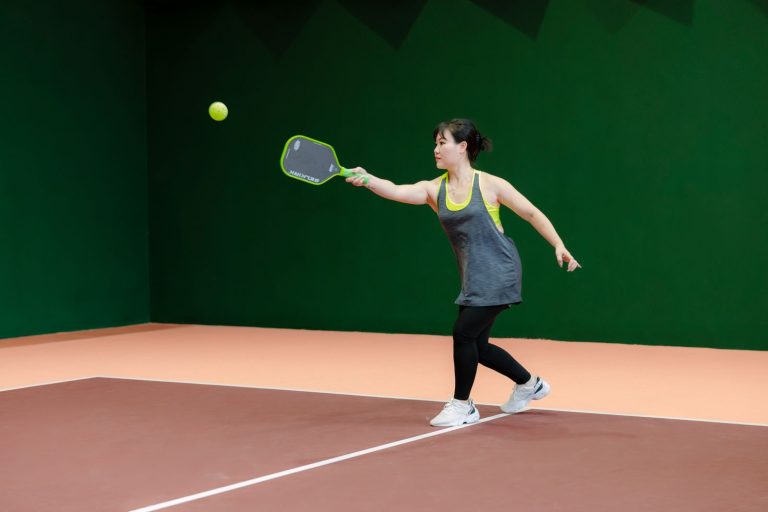
Swing low to high, like a long, smooth pendulum. Shift your weight from your back foot to your front foot as you swing.
-
Finish toward the target, with your paddle pointing at the spot you are aiming for, roughly shoulder height.
Keep your eyes on the ball until it leaves the paddle.
Where to aim
Aim deep, about two to three feet inside the baseline, and away from the sidelines. A deep serve keeps the returner back and makes it harder for them to rush the net after their return.
Once deep serves feel automatic, aim at the returner’s backhand, usually the weaker side. Add speed or spin only when you can land 9 out of 10 serves in.
Common serve faults
These are the faults that cost beginners the most points:
-
Landing in the kitchen. The kitchen line counts as part of the kitchen on the serve, so a ball that lands on it is a fault. All other lines are good.
-
Serving into the net. Aim higher over the net than you think you need.
-
Serving long or wide. Usually a sign of swinging too hard.
-
Contact above the waist on a volley serve. Let the ball drop lower before you hit it.
-
Tossing the ball on a drop serve instead of dropping it.
-
Stepping on the baseline as you swing.
-
Serving from the wrong side or out of turn. Check the score and your position before every serve.
What about the net? If your serve clips the net and still lands in the correct service court, it is a live ball. Since 2021, let serves are no longer replayed, so be ready to play on.
FAQ
Is the drop serve better than the volley serve?
Neither is better for everyone. The drop serve is easier to learn and harder to fault on, while the volley serve can feel more natural for players with a tennis or racquetball background. Pick the one you can repeat most consistently.
Do you get a second serve in pickleball?
No. Each server gets one attempt per rally. If the serve is a fault, the serve passes to your partner or to the other team.
What happens if the serve hits the net?
If it clears the net and lands in the correct service court, play continues. If it hits the net and falls short or lands in the wrong area, it is a fault.
Quick recap
-
One serve per rally, so consistency beats power.
-
Keep at least one foot behind the baseline and off the line when you hit.
-
Volley serve: upward arc, contact below the waist, paddle head below the wrist.
-
Drop serve: drop the ball without tossing it, then use any swing after the bounce.
-
The serve must land in the diagonal service court, past the kitchen line.
-
Aim deep and let the serve start the point, not finish it.