Pickleball Court Dimensions and How to Set Up a Court at Home
One of the best things about pickleball is how little space it needs. A full court is less than a third the size of a tennis court, which means you can often set one up in a driveway, a cul-de-sac, a school gym or an old tennis court.
This guide covers the official measurements, how much space you really need around the lines and a simple step-by-step method for marking a court at home.
Official pickleball court dimensions
USA Pickleball sets the standard measurements used across the United States. The same court is used for singles and doubles.
-
Court size: 20 feet wide by 44 feet long
-
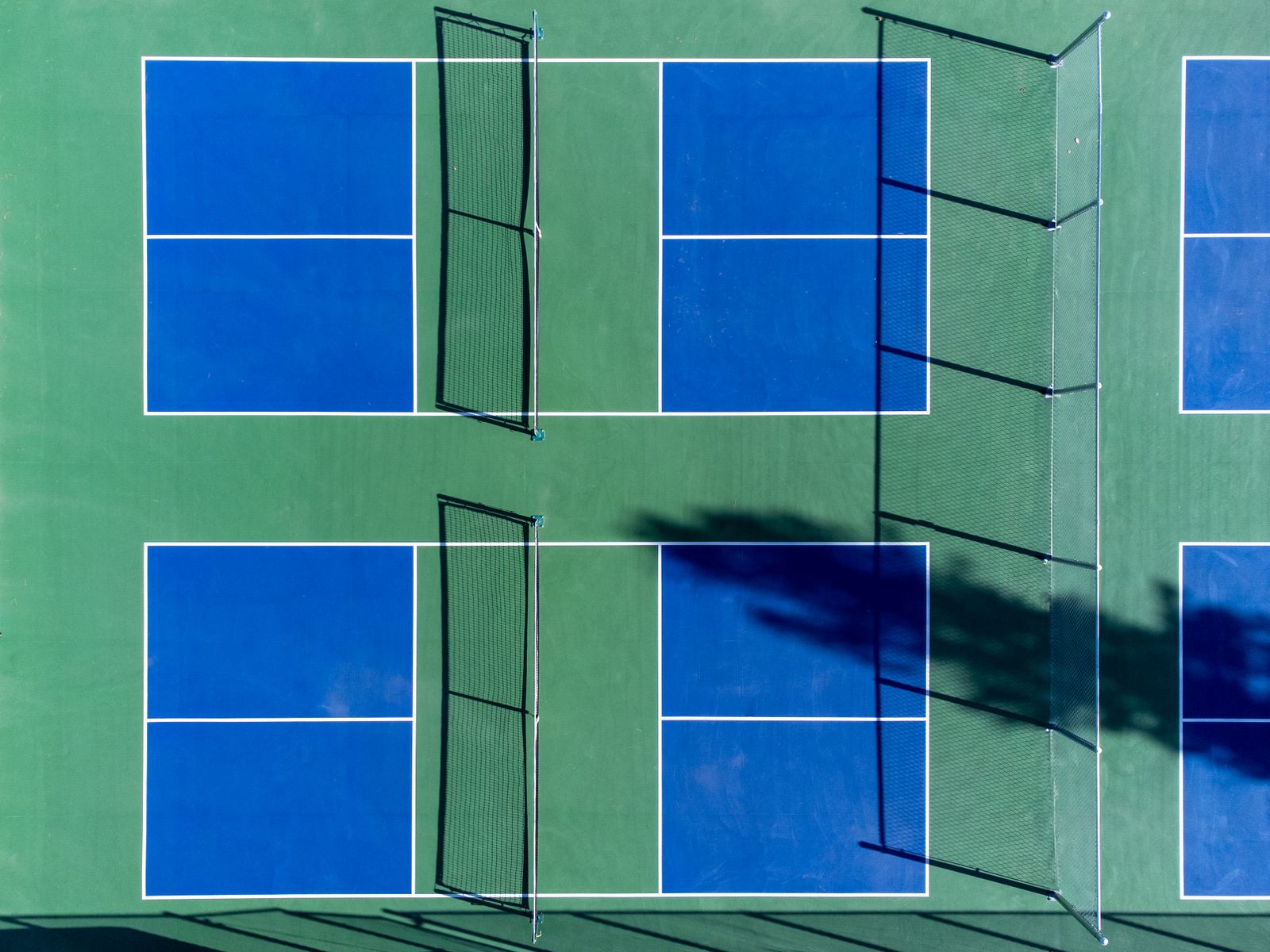
Each side of the net: 20 feet wide by 22 feet deep
-
Non-volley zone (the kitchen): 7 feet deep on each side of the net, running the full 20-foot width
-
Service courts: each side has two service courts, 10 feet wide by 15 feet deep, split by the centerline
-
Line width: 2 inches, usually white or a color that contrasts with the court
All measurements are taken to the outside edges of the lines. That means the lines are part of the court: a ball that lands on the baseline or sideline is in.
Pickleball net height
The net is slightly lower in the middle than at the ends:
-
36 inches high at the sidelines
-
34 inches high at the center
Official nets are at least 21 feet 9 inches wide so they span the full court, and the posts sit just outside the sidelines. Portable nets can sag, so check the center height before you play.
How much total space you need
The lines themselves cover 20 by 44 feet, but you need room around them to move. Players often step well behind the baseline to return a deep serve, and wide angles pull you past the sidelines.
A commonly used guideline is:
-
Minimum total playing area: 30 by 60 feet
-
Preferred total playing area: 34 by 64 feet
That gives you about 5 to 7 feet on each side and 8 to 10 feet behind each baseline. Less space works for casual games, but you will feel cramped, and walls or curbs close to the lines are a safety risk.
Choosing a surface
Pickleball can be played on almost any hard, flat surface. The most common options are:
-
Asphalt or concrete: the standard for outdoor courts and driveways. Smooth, even surfaces work best.
-
Acrylic-coated courts: the textured paint used on most dedicated outdoor courts. It adds grip and gives a consistent bounce.
-
Gym floors: wood or synthetic floors used for indoor play. They are fast and smooth.
-
Modular sport tiles: interlocking plastic tiles that can go over concrete. They are a popular option for permanent backyard courts.
Avoid grass, gravel and surfaces with big cracks or slopes: the bounce is unreliable and uneven ground is easy to twist an ankle on. Sweep away sand and grit before playing.
How to set up a court at home or on a driveway
What you need
-
A 100-foot tape measure (a 50-foot tape works with an extra step)
-
Painter’s tape, outdoor court tape or sidewalk chalk
-
Four small markers, such as cones or coins, for the corners
-
A portable pickleball net
-
A helper, which makes measuring much easier
Step-by-step
-
Check your space. Measure the length and width of the area. A standard two-car driveway is often around 20 feet wide, so you may fit the court width but not the extra room on the sides. Keep clear of streets, steps and parked cars.
-
Mark the baseline. Lay down a straight 20-foot line at one end. This is your first baseline.
-
Mark both sidelines. From each end of the baseline, measure 44 feet straight out and place a marker.
-
Square the court. Measure the two diagonals, from corner to opposite corner. On a 20 by 44 foot court, each diagonal should be about 48 feet 4 inches. If the two diagonals match, your court is square. If not, adjust the far corners until they do.
-
Connect the corners. Mark the two sidelines and the second baseline.
-
Mark the net line. Find the midpoint of each sideline, 22 feet from each baseline. This is where your net goes.
-
Mark the kitchen lines. Measure 7 feet from the net line toward each baseline and draw a line across the full width of the court.
-
Mark the centerlines. On each side, draw a line from the middle of the kitchen line to the middle of the baseline, 10 feet in from each sideline. Do not draw a centerline inside the kitchen.
-
Set up the net. Center it on the net line and check the height: 36 inches at the sidelines and 34 inches at the middle.
Tape or chalk?
-
Sidewalk chalk is cheap and washes away with rain or a hose. It is good for testing a layout but fades quickly.
-
Painter’s tape is easy to remove but does not grip rough surfaces well and peels after a few sessions outdoors.
-
Outdoor court tape or line-marking kits are designed for this job. They last longer and are easier to see.
-
Paint is permanent, so only use it on surfaces you own and plan to dedicate to pickleball, and check with your HOA or landlord first.
Portable nets
A portable net is the easiest way to start. Most fold into a carrying bag and set up in a few minutes without tools. When choosing one, look for:
-
Regulation width, so it spans the full court
-
A center support or adjustable strap to hold the 34-inch center height
-
A sturdy base with weighted or wide feet, since wind can tip lightweight nets
Converting a tennis court
Tennis courts make great pickleball spaces. You have a few options:
-
Use the tennis net. You can mark one pickleball court on each side of a tennis net. The tennis net is 36 inches at the center and higher at the posts, so lower the center strap to 34 inches if you can. The sides will still be a little high, which is fine for casual play.
-
Add portable nets. A standard tennis court area is large enough to fit up to four pickleball courts with portable nets, depending on layout and fencing.
-
Use temporary lines. Tape lines in a color that stands out from the tennis lines so players do not confuse them.
If the court belongs to a park, school or club, ask before taping or chalking lines. Many facilities have rules about markings, and some already have pickleball lines painted.
FAQ
Is a singles court smaller than a doubles court?
No. Unlike tennis, pickleball uses the same 20 by 44 foot court for both singles and doubles.
Can I play on a shorter driveway?
Yes, for practice. A half court with a net works well for dinking and volley drills. Just remember that a shortened court changes how deep serves and returns land, so it is not ideal for full games.
Are kitchen lines part of the kitchen?
Yes. The kitchen line belongs to the non-volley zone, so stepping on it while volleying is a fault, and a serve that lands on it is short.
Quick recap
-
A pickleball court is 20 by 44 feet, with a 7-foot kitchen on each side of the net.
-
The net is 36 inches high at the sidelines and 34 inches at the center.
-
Aim for a total area of at least 30 by 60 feet, and ideally 34 by 64 feet.
-
Square your court by checking that both diagonals measure about 48 feet 4 inches.
-
Use chalk or court tape for temporary lines, and a portable net for quick setup.