Pickleball Rules for Beginners: The Complete Simple Guide
Pickleball is easy to pick up, but the first game can feel confusing if nobody explains the rules. This guide covers everything a beginner needs to play a full game with confidence: the court, the serve, the two-bounce rule, the kitchen, faults and scoring.
The rules below follow the current USA Pickleball Official Rulebook, which is used for recreational and tournament play in the United States.
The basics in 30 seconds
-
Pickleball is played on a badminton-sized court with a low net, solid paddles and a plastic ball with holes.
-
Most games are doubles (two players per side), but singles is played too.
-
The serve is underhand and goes diagonally across the court.
-
The ball must bounce once on each side before anyone can hit it out of the air.
-
You cannot volley while touching the 7-foot zone next to the net, called the kitchen.
-
In standard scoring, only the serving team can score. Games are usually played to 11, and you must win by 2.
The court and equipment
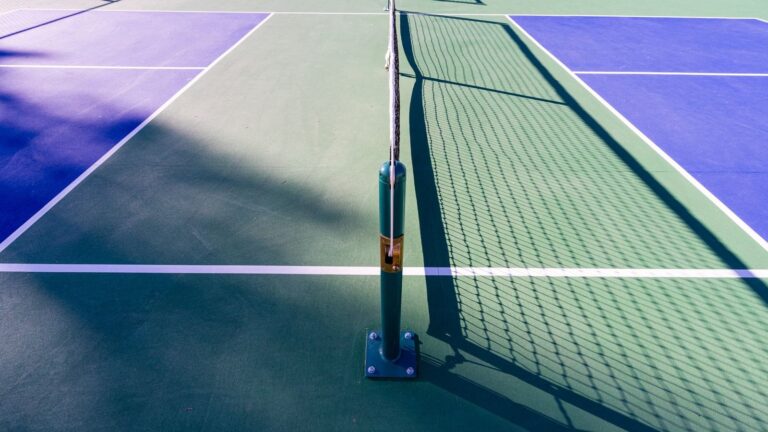
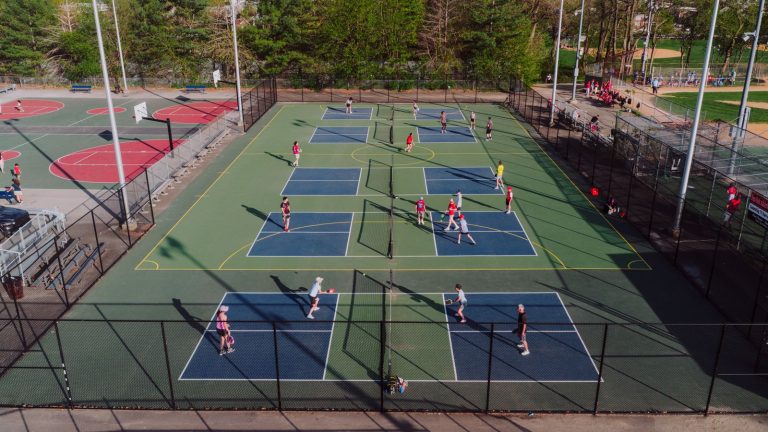
A pickleball court is 20 feet wide and 44 feet long, the same size as a doubles badminton court. The net is 36 inches high at the sidelines and 34 inches high in the middle.
Each side of the court has three parts:
-
The non-volley zone (the kitchen): the 7-foot area closest to the net.
-
The right service court and the left service court: the two boxes behind the kitchen, divided by the centerline.
-
The baseline: the back line of the court, where the server stands.
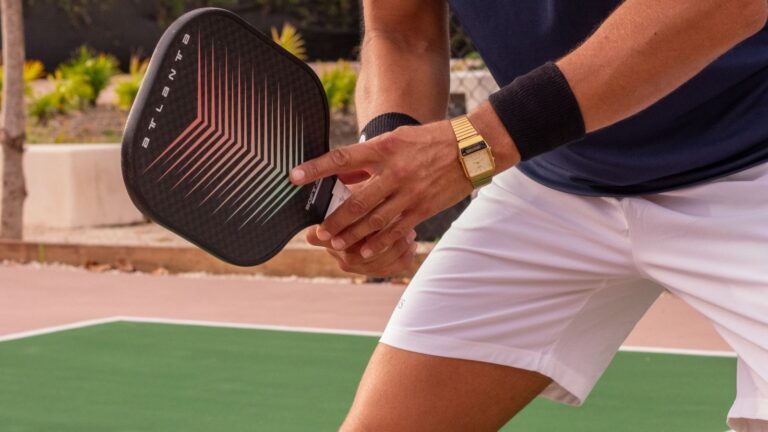
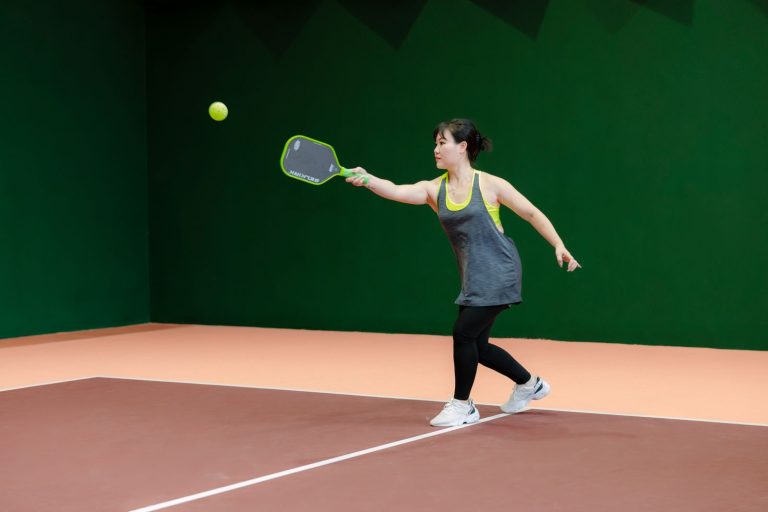
You need a solid paddle (wood, composite or graphite) and a perforated plastic ball. Outdoor balls are usually harder with smaller holes; indoor balls are softer with larger holes. For full measurements, see our guide to court dimensions.
How to serve
Every point starts with a serve. These are the key serving rules:
-
Stand behind the baseline. At least one foot must be on the ground behind the baseline when you hit the ball, and neither foot may touch the court or the baseline.
-
Serve diagonally. The ball must land in the service court diagonally across from you.
-
Clear the kitchen. A serve that lands in the kitchen or on the kitchen line is a fault. A serve that lands on the centerline, sideline or baseline of the correct box is in.
-
Use a legal motion. For a volley serve, your paddle must move in a clear upward arc, the paddle head must not be above your wrist, and you must contact the ball no higher than your waist. You can also use a drop serve: let the ball fall from a natural height, without throwing it or bouncing it down, and hit it after it bounces.
-
Do not add spin with your hand. You may put spin on the ball with the paddle, but not by twisting or flicking the ball as you release it.
-
You get one attempt. There is no second serve. If the serve clips the net and still lands in the correct service court, it is in play.
In doubles, every new service turn starts from the right side, and partners switch sides only when their team wins a point. For technique and the finer points, see our guide to serve rules.
The two-bounce rule
This is the rule that makes pickleball different from tennis. After the serve:
-
The receiving team must let the serve bounce before returning it.
-
The serving team must let the return bounce before hitting it.
After those two bounces, either team can volley (hit the ball before it bounces) or play it off the bounce. That is why the serving team usually waits near the baseline until the return lands.
The kitchen (non-volley zone)
The kitchen is the 7-foot zone on both sides of the net. The rule is simple: you cannot volley while you are touching the kitchen, and that includes the kitchen line.
-
You can step into the kitchen at any time to hit a ball that has bounced.
-
If your momentum carries you into the kitchen after a volley, it is still a fault, even if the ball is already dead.
-
After you have been in the kitchen, you must get both feet back on the ground outside it before you volley again.
The kitchen rule stops players from standing at the net and smashing every ball, which is why soft shots like the dink are so important.
Common faults
You lose the rally if you:
-
Hit the ball out of bounds. A ball that lands on any line is in, except a serve that lands on the kitchen line.
-
Hit the ball into the net or under it.
-
Volley before the two-bounce rule allows it.
-
Volley while touching the kitchen.
-
Let the ball bounce twice on your side.
-
Get hit by the ball. The one exception is your paddle hand: a ball that strikes the hand holding the paddle, below the wrist, counts as a paddle hit.
-
Touch the net or net post with your body, clothing or paddle while the ball is in play.
How scoring works
In traditional scoring, only the serving team can win a point. If the receiving team wins the rally, they do not score; instead, the serve passes to the other player or team (a “side out”).
In doubles, the server calls three numbers before each serve: the serving team’s score, the receiving team’s score and the server number (1 or 2). Each game starts at 0-0-2 because the first serving team gets only one server at the start of the game.
Games are normally played to 11 points, and you must win by 2. Some tournaments play to 15 or 21. For a full walkthrough with examples, read our guide on how to keep score.
Line calls and etiquette
In recreational play, each team calls the lines on its own side of the court. You should only call a ball “out” if you clearly saw space between the ball and the line. If you are not sure, the ball is in. Calling the score clearly, waiting your turn at open play and tapping paddles at the end of a game will make you welcome at any court.
FAQ
Can the ball hit the net during a rally?
Yes. A ball that clips the top of the net and lands in bounds is in play, on the serve and in rallies.
Can I switch the paddle to my other hand?
Yes. You can hold the paddle with one or both hands and switch hands at any time. You just cannot use or carry two paddles.
What happens if the server calls the wrong score?
Any player may stop play to fix the score, but only before the return of serve is hit; the rally is then replayed. If nobody notices until after the rally, the result stands and the score is corrected before the next serve.
Quick recap
-
Serve underhand, diagonally and past the kitchen, with one attempt.
-
Let the serve bounce and let the return bounce.
-
Never volley while touching the kitchen or its line.
-
Lines are in, except the kitchen line on the serve; when in doubt, call it in.
-
Only the serving team scores; play to 11 and win by 2.
Rules are updated from time to time, so for tournament play always check the current official USA Pickleball rulebook.